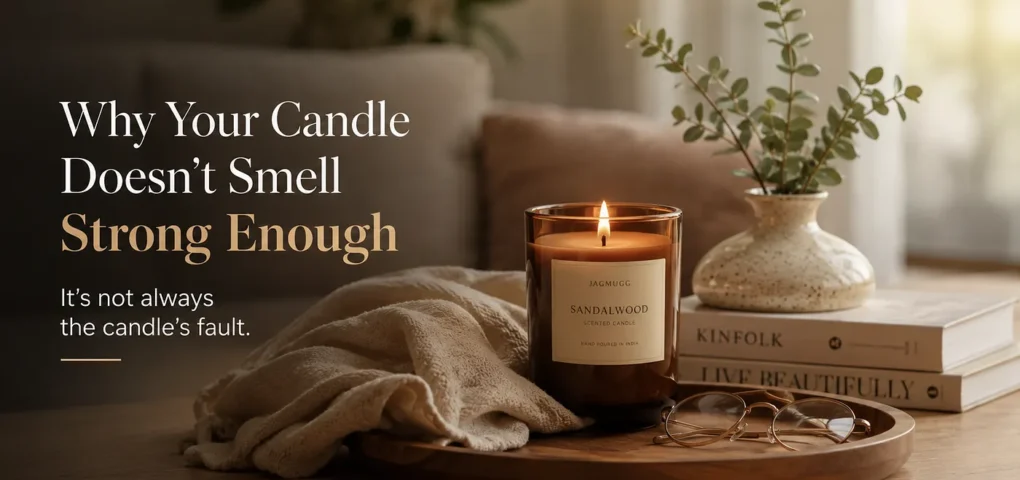
(And Why the Candle May Not Be the Problem)
Understanding the Science, Space and Habits Behind Candle Fragrance
There is a familiar disappointment many candle lovers have experienced.
You light a beautifully scented candle after a long day, expecting the room to gradually fill with fragrance. The label promised notes of vanilla, sandalwood, citrus or blooming florals. You settle into the moment, wait for the scent to unfold, and then begin wondering why nothing seems to be happening.
The immediate conclusion is often that the candle is weak.
In reality, the answer is rarely that simple.
One of the most searched fragrance-related questions today is, “Why doesn’t my candle smell strong enough?” The assumption behind that question is that scent strength depends entirely on the candle itself. While candle quality certainly matters, the way fragrance behaves inside a space is influenced by far more than the wax inside the jar.
The size of the room, airflow, burn time, fragrance composition and even the human brain play a role in how strongly a candle is perceived.
Before blaming the candle, it helps to understand what is actually happening when fragrance is released into a room.
Expectation vs. Reality
Modern consumers are surrounded by products that deliver fragrance instantly.
Room sprays provide an immediate burst of scent. Reed diffusers work continuously in the background. Air fresheners are designed to make themselves known within seconds.
Candles operate differently.
A scented candle is designed to release fragrance gradually through heat. Rather than flooding a room immediately, it creates a layered experience that develops over time. The fragrance molecules are carried into the air as the wax melts, allowing the scent to slowly settle into the space.
This process takes patience.
Many people expect a candle to transform a room within a few minutes of lighting it. When that doesn’t happen, they assume the fragrance is weak. In reality, most premium candles are designed to create atmosphere rather than immediate impact.
A well-crafted candle rarely announces itself loudly. It reveals itself gradually.
Burn Time Has a Bigger Impact Than Most People Realise
One of the most common reasons a candle does not smell strong enough is insufficient burn time. Fragrance is released most effectively once a full melt pool has formed across the surface of the candle. Until that happens, much of the fragrance remains trapped inside the unmelted wax.
Depending on the size of the candle, this process can take anywhere from one to three hours. Smaller candles typically develop a full melt pool within one to two hours. Larger candles often require considerably longer.
When a candle is extinguished too early, the fragrance never gets the opportunity to fully open. The result is a scent experience that feels muted, even when the fragrance load inside the candle is perfectly adequate.
Think of it like brewing tea. Removing the tea leaves after a few seconds would never deliver the intended flavour. Fragrance behaves in much the same way.
Room Size Can Change Everything
Another overlooked factor is the relationship between candle size and room size.
A candle that performs beautifully in a bedroom may struggle inside a large open-plan living area.
Fragrance disperses naturally as it moves through the air. The larger the space, the more room there is for scent molecules to spread out. This means the same candle can feel strong in one environment and surprisingly subtle in another.
As a general guideline:
- Small rooms such as bedrooms, reading corners and bathrooms are often well suited to a single candle.
- Medium-sized living spaces may benefit from larger candles or stronger fragrance profiles.
- Open layouts and expansive rooms frequently require multiple fragrance sources to create noticeable scent coverage.
When people say their candle fragrance is not filling the room, room size is often one of the biggest reasons.
Airflow May Be Working Against You
Even a high-quality scented candle can struggle in the wrong location.
Open windows, ceiling fans, air conditioning vents and frequently used doorways all influence how fragrance travels through a room. While a small amount of air movement helps distribute scent, excessive airflow can disperse it before it has a chance to accumulate.
A candle positioned beneath a ceiling fan or beside an open window may never achieve the fragrance concentration needed for a satisfying experience.
The scent is present. It simply never remains in one place long enough to be fully appreciated.
For stronger fragrance performance, candles generally work best in relatively stable environments where airflow is gentle rather than constant.
Not All Candle Ingredients Perform the Same Way
When discussing candle scent throw, ingredient quality matters enormously.
The strength and character of a candle’s fragrance are influenced by several factors:
- The type of wax used
- The quality of fragrance oils
- Fragrance concentration
- Wick performance
- Burn consistency
Soy wax candles, for example, are known for producing a cleaner burn and a more nuanced fragrance experience. Rather than delivering an aggressive burst of scent, soy wax often releases fragrance gradually, allowing individual notes to emerge over time.
Paraffin wax candles are frequently perceived as stronger because they can release fragrance more aggressively. However, stronger does not always mean better.
A refined fragrance experience is often measured by balance, complexity and longevity rather than sheer intensity.
The best candles are designed to create an atmosphere, not overwhelm it.
Your Brain May Be Filtering the Fragrance Out
Perhaps the most surprising explanation for a candle that seems to have no smell is something called olfactory fatigue.
More commonly known as nose blindness, this phenomenon occurs when the brain becomes accustomed to a scent and gradually stops paying attention to it.
The fragrance itself has not disappeared.
Your brain has simply decided that the smell is no longer important information. This happens constantly in everyday life. People stop noticing their own perfume. Homeowners become unaware of the scent of their homes. Even strong fragrances can fade into the background after prolonged exposure.
A simple test is to leave the room for several minutes and return.
In many cases, the fragrance suddenly becomes noticeable again.
The candle was working all along.
Why Stronger Isn’t Always Better
The candle industry has unintentionally created a misconception that the strongest candle is automatically the best candle.
In reality, excessively strong fragrances can become tiring very quickly.
An overpowering candle may dominate a room, interfere with meals, trigger headaches or create a synthetic feeling that distracts from the experience rather than enhancing it.
The most sophisticated fragrances often operate differently.
They sit quietly in the background, subtly shaping the mood of a space. They reveal different layers as they burn. They become part of the environment rather than competing for attention.
This is often what distinguishes a luxury fragrance experience from a purely strong one.
The Goal Should Be A Better Fragrance, Not Stronger
If you have ever wondered why your scented candle does not smell strong enough, the answer may have less to do with the candle itself and more to do with the conditions surrounding it.
Burn time, room size, airflow, wax composition and even human biology influence how fragrance is experienced. A candle is not designed to perform like an aerosol spray. It is designed to create a gradual sensory experience that unfolds over time. The next time a candle feels weaker than expected, consider whether it has been given enough time, the right environment and the right scale of space to do what it was created to do. Because the most memorable fragrances are rarely the loudest ones. They are the ones that slowly become part of a moment, a room and eventually a memory.
Discover Fragrances that Unfold Naturally
Explore Jagmugg’s collection of handcrafted scented candles designed to evolve beautifully as they burn and create an atmosphere that lingers long after the flame is gone.
Frequently Asked Questions (FAQs)
Why does my candle not smell strong enough?
Your candle may not smell strong due to factors like short burn time, large room size, airflow, or nose blindness. It’s not always a product issue.
How long should I burn a candle for maximum scent?
You should burn a candle for at least 1–3 hours until a full melt pool forms. This allows the fragrance to release properly.
Do bigger rooms affect candle fragrance?
Yes, larger rooms require stronger candles or multiple candles. A single candle may not be enough to fill a big space.
What is nose blindness in candles?
Nose blindness (olfactory fatigue) happens when your brain stops noticing a constant scent after a few minutes, even if it’s still present.
Are soy wax candles less strong?
Soy wax candles often have a more subtle and layered fragrance compared to paraffin candles, which can feel stronger but less refined.
How can I make my candle smell stronger?
Burn it longer, place it in a smaller room, reduce airflow, and choose high-quality candles with good fragrance concentration.