Why India’s Greatest Landmarks Deserve More Than a Place on a Souvenir Shelf
Some places refuse to leave us
There are journeys we remember because of the destinations we visited, and then there are journeys we remember because of how they quietly changed the way we looked at the world. The winding roads that disappear into the mountains. The intricate carvings were weathered by centuries. The marketplaces where every corner tells a story. The silence that exists only in places untouched by urgency.
Long after we’ve returned home, these moments continue to exist – not as photographs or souvenirs, but as feelings. They shape our conversations, influence our curiosity, and often become the stories we find ourselves retelling years later.
And yet, the objects we choose to bring back rarely carry the same weight.
A miniature monument. A magnet. A keychain. A postcard.
Objects that acknowledge where we’ve been, but seldom capture why the place mattered in the first place.
Perhaps the problem has never been with souvenirs themselves. Perhaps we’ve simply accepted that memories are meant to sit on shelves instead of becoming part of everyday life.
When Did We Decide That Heritage Was Only Meant to Be Remembered?
India has never been short of extraordinary architecture.
Across the country stand structures that have survived changing empires, evolving cultures and generations of people who have admired them for entirely different reasons. Some visit them seeking history. Others arrive in search of beauty. Many simply come because these landmarks have become inseparable from the cities they represent.
Over time, these places stop belonging only to historians or travellers.
They become part of our collective imagination.
Mention Jaipur, and a certain silhouette appears almost instantly. Speak of Agra, and centuries of craftsmanship come rushing back. Think of Varanasi, Hampi, Mysore or Kolkata, and architecture becomes impossible to separate from memory.
These are not merely destinations on a map.
They are visual languages that define the identity of entire cities.
Yet when we attempt to preserve these experiences, we often reduce them to decorative memorabilia – objects that celebrate recognition rather than interpretation.
The architecture stays behind.
The story slowly fades.
The Future of Indian Design Doesn’t Lie in Replication. It Lies in Interpretation.
For decades, design has borrowed inspiration from around the world. Scandinavian minimalism found its way into our homes. Japanese craftsmanship influenced the objects we admire. Mediterranean palettes shaped our interiors.
But somewhere along the way, we began overlooking the richness that already existed around us.
India has always been a design destination.
Not because of trends.
Because of timelessness.
Our architecture has mastered proportion before modern design schools gave it a name. Our artisans understood texture before luxury became a category. Our cities have been telling stories through stone, wood and craftsmanship for centuries.
Perhaps the next chapter of Indian design is not about looking further.
Perhaps it is about looking closer.
Not to recreate heritage exactly as it exists.
But to reinterpret it for contemporary living.
Because design reaches its highest purpose when it allows history to evolve rather than remain untouched.
What If Landmarks Became Part of Everyday Living?
This question has quietly shaped many of our conversations at Jagmugg.
Not because we wanted to create another souvenir.
And certainly not because we believed architecture should become decoration.
Instead, we wondered whether the places that shape our memories could also shape the objects we use every day.

What if a wardrobe carried the story of a city?
What if opening a drawer reminded us of a journey rather than simply storing our belongings?
What if home fragrance wasn’t only about scent, but also about place?
These questions eventually led us to rethink what a keepsake could become.
Not static.
Not ornamental.
But functional.
An object designed to participate in everyday life instead of observing it from a shelf.
Kedarnath Was Never Chosen Only for What It Represents. It Was Chosen for What It Has Endured.
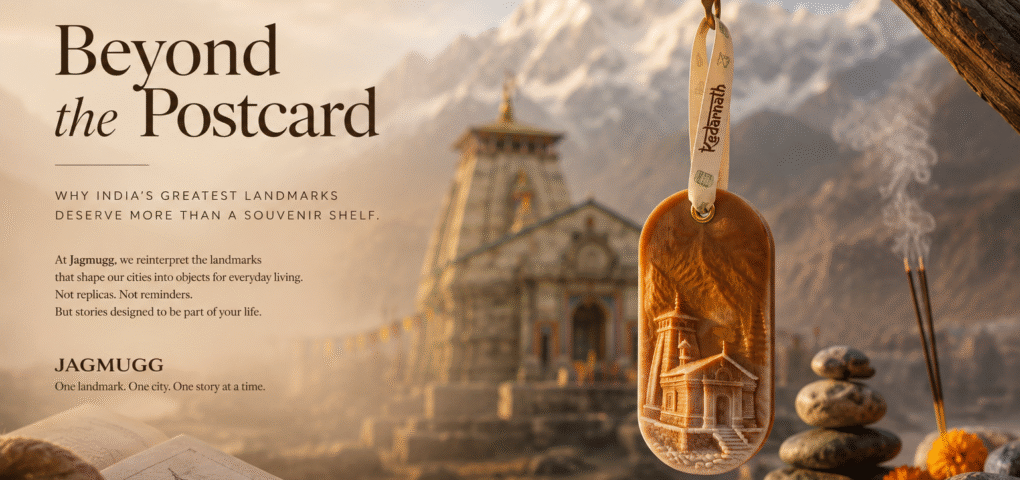
The first chapter of this journey takes inspiration from Kedarnath.
For many, it is a place of faith.
For others, it is an engineering marvel nestled within one of the world’s most demanding landscapes. For architects, it represents enduring craftsmanship. For travellers, it is a destination that challenges both body and perspective. For photographers, it is a composition unlike any other.
Its meaning changes with every person who encounters it.
That is precisely what makes it remarkable.
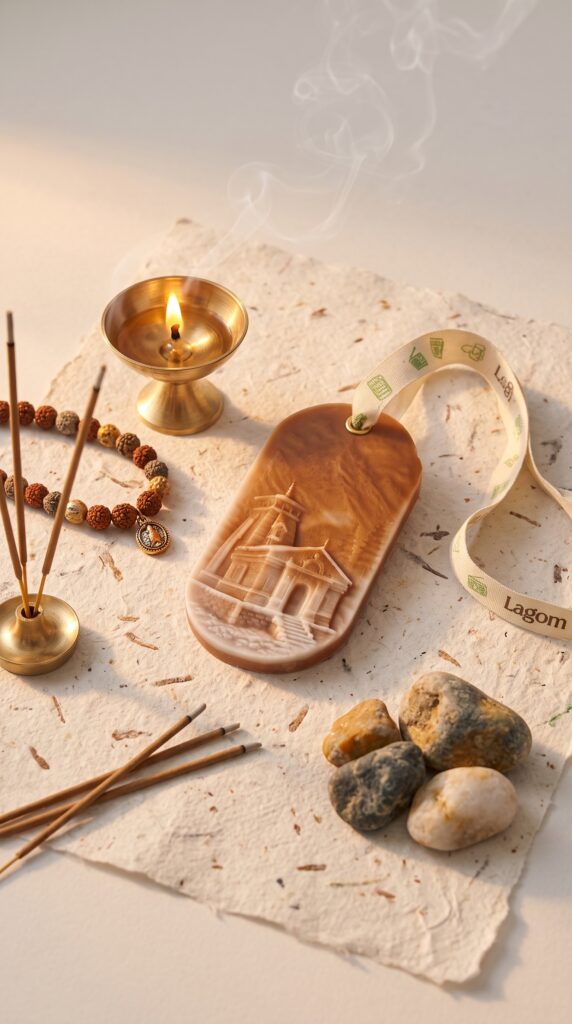
Rather than recreating the monument itself, we sought to reinterpret its enduring presence through an object designed for contemporary homes – a handcrafted soy wax sachet infused with the warm familiarity of sandalwood and vanilla.
It hangs inside wardrobes. It rests among linens. It quietly fragrances everyday spaces.
Its purpose isn’t to imitate architecture.
Its purpose is to continue the conversation architecture began.
One Product Cannot Tell the Story of India. A Collection Can.
India cannot be understood through a single city.
Nor can its design language be represented by one monument.
Every region carries its own architectural vocabulary. Every landmark reflects a different chapter of craftsmanship, geography and culture. Together, they form a living archive of ideas that continue to inspire generations.
This is why Kedarnath is not the destination.
It is the beginning.
The vision extends far beyond one place, one fragrance or one object. It imagines a growing collection where every design is rooted in a landmark, every object celebrates a city, and every product becomes a conversation about India’s extraordinary design heritage.
Not through nostalgia.
But through relevance.
Not through replication.
But through thoughtful reinterpretation.
Design Is How We Choose to Remember
The homes we build are filled with stories.
Some are inherited. Others are collected over time. The books we display, the art we frame, the objects we refuse to part with, each one says something about what we value.
At Jagmugg, we believe the places that inspire us deserve to become part of those stories.
Not as souvenirs waiting to gather dust.
But as objects that continue to live with us, evolve with us and quietly remind us that great design is often born from great places.
Perhaps that’s what the future of Indian design looks like.
Not chasing the world’s stories.
But learning to tell our own.
Jagmugg isn’t building a collection of products.
We’re building a design archive of India – one landmark, one city, one story at a time.